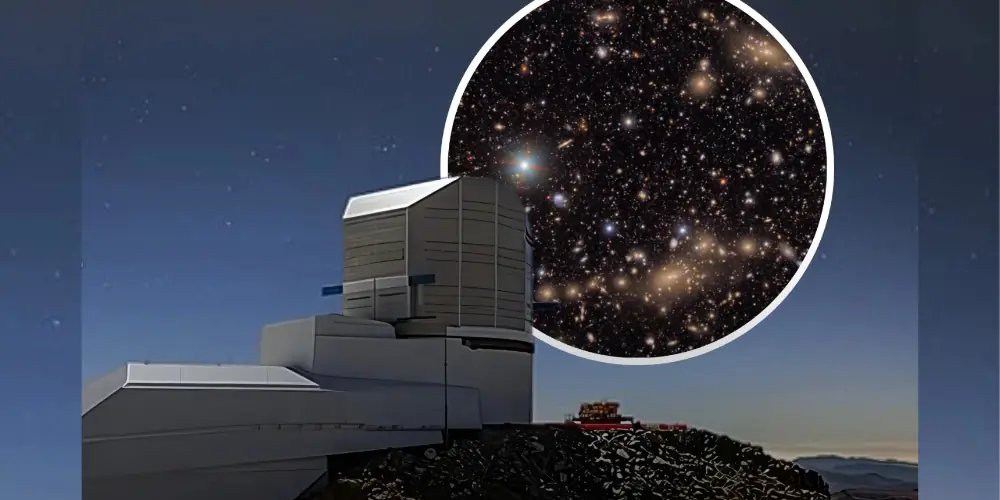
The Vera C. Rubin Observatory has officially raised the bar for what “big data” means in astronomy. After releasing its first batch of cosmic images, the observatory isn’t just capturing the night sky—it’s creating one of the most extensive visual datasets humanity has ever seen.
Powered by the world’s largest digital camera, the images are so detailed and expansive that processing them requires not just high-speed networks, but a whole digital ecosystem: seven international data brokers, three massive data centers, and a uniquely named management system called the Data Butler.
The Scale of Rubin’s Cosmic Images
Instagram | rubin_observatory | Rubin Observatory will produce a staggering 20 terabytes of data and 10 million alerts each night.
What makes Rubin Observatory’s contribution truly staggering is the sheer volume and precision of the data it collects. Once it enters full operation, the observatory will generate 20 terabytes of data each night, issuing around 10 million alerts to astronomers. These alerts aren’t casual notifications—they’re potential discoveries like supernovas, moving asteroids, or transient cosmic events that require immediate scientific attention.
Rubin’s camera doesn’t just take pictures—it creates a high-definition, time-lapse map of the universe. Over a 10-year survey called the Legacy Survey of Space and Time (LSST), Rubin will accumulate about 500 petabytes of data. To give that some scale: it’s roughly the same as half a million 4K Blu-ray discs.
How the Data Moves and Who Handles It
The Rubin Observatory sits high on a mountaintop in Chile, offering a clear view of the Southern Hemisphere sky. After capturing the data, the system sends it through a dedicated fiber link to the SLAC National Accelerator Laboratory in California.
From there, the team replicates and distributes the data to the IN2P3 center in France and a U.K.-based network, allowing for global collaboration and reliable backup.
1. SLAC handles 35% of the data processing
2. IN2P3 manages 40%
3. The U.K. system processes the remaining 25%
Each center supports one another to avoid delays or data loss, a crucial strategy when dealing with alerts that need fast response.
What Is the “Data Butler”?
With cosmic images this large, astronomers can’t simply “download a file” and start working. The dataset is too vast for that kind of interaction. That’s where the Data Butler steps in. Think of it as a hyper-organized digital concierge that tracks every image by time, location, object, and even what the camera was focused on.
It gives researchers the ability to search using specific astronomy terms—coordinates, object types, timescales—without needing to know where the files are stored or how they’re labeled. This makes Rubin’s data not only searchable but useful in real time, especially for spotting fleeting cosmic phenomena.
Brokers: Filtering Millions of Alerts
With 10 million alerts every night, how can any astronomer possibly keep up? That’s the job of seven data brokers, each based in different parts of the world. These systems act like smart filters, sorting the massive influx of data into manageable chunks based on what specific scientists are looking for.
Examples include:
ALeRCE in Chile, using machine learning to classify events
ANTARES in the U.S., designed for quick-response alerts
Lasair in the U.K., specializing in short-lived cosmic transients
Some brokers rely on AI, while others stick to proven modeling systems. Astronomers sign up to a broker, define their interest areas, and receive only relevant alerts—sometimes just two or three out of millions.
Why These Cosmic Images Matter
Instagram | rubin_observatory | Rubin’s cosmic images are key to deciphering dynamic cosmic processes.
The cosmic images Rubin collects are more than beautiful snapshots. They’re key to understanding dynamic processes in the universe—kilonovas, supernovas, gravitational waves, even unidentified phenomena. These datasets will remain useful for decades, possibly outliving the current generation of scientists working on them.
The Rubin Observatory surveys a quarter of the Southern Hemisphere sky every single night. It doesn’t miss a thing. That level of consistency allows researchers to spot patterns, changes, and rare events that would otherwise go unnoticed.
And yet, Rubin isn’t the final chapter in data-heavy astronomy. Teams are already applying the lessons from Rubin to projects like the Square Kilometre Array (SKA)—a massive radio telescope initiative that will dwarf even Rubin’s colossal data output.
Why Rubin’s Data Is Just the Beginning
The Rubin Observatory is changing how astronomy works. Instead of simply watching the sky, it actively tracks and responds every night. Its cosmic images come with incredible detail, scale, and speed, reshaping the way we explore space. Today, Rubin leads the charge. However, the tools and systems built around it are also laying the foundation for future missions.
These aren’t ordinary images. They’re signals from the farthest reaches of time and space. Thanks to the Data Butler and its powerful network, astronomers now have the ability to capture, sort, and respond faster than ever.