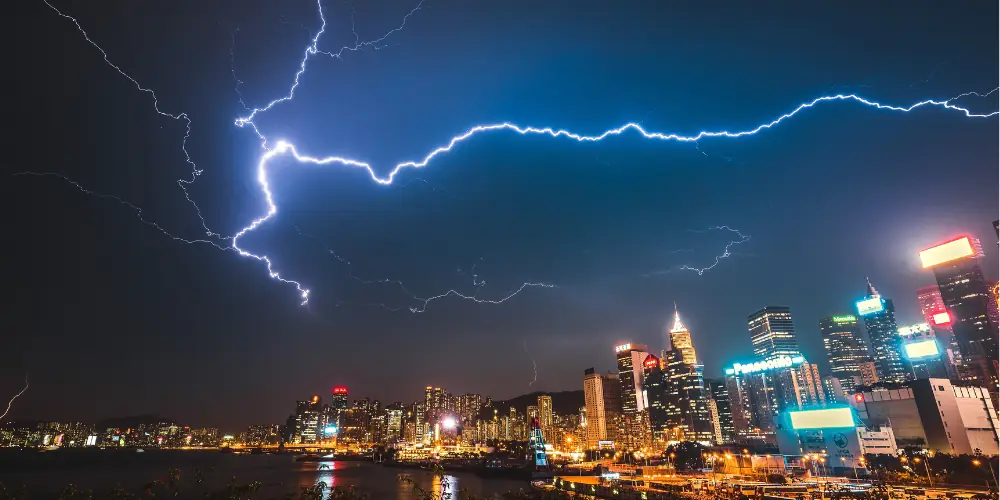
Lightning might seem like a sudden burst from the sky, but the science behind it runs deep—and recent research has added an electrifying twist. Scientists have long known that thunderstorms build electrical charges until they discharge in brilliant flashes of lightning. What’s new is the evidence pointing to an unexpected trigger: cosmic rays.
Researchers at Los Alamos National Laboratory have uncovered clues that suggest lightning may actually start with particles from outer space, opening a fresh angle on this natural phenomenon.
A Shift in Understanding
Thunderclouds have always been the stage for lightning. Traditional understanding says it begins when opposite charges build up in a storm—positive at the top, negative at the bottom. Once the difference becomes intense enough, it sparks. Simple enough.
But that explanation skips a puzzling detail. Observations show lightning typically starts with a fast, positive discharge, even before the expected negative leader appears. Scientists couldn’t fully explain this sequence—until now.
Here’s where cosmic rays come in.
What Are Cosmic Rays?
Instagram | nasa | When cosmic rays hit the atmosphere, they create extensive air showers of particles.
Cosmic rays are high-energy particles that shoot through the universe and constantly collide with Earth’s atmosphere. When they hit, they don’t just disappear. They spark what’s known as extensive air showers—basically, a chain reaction that sends electrons and positrons (their positively charged counterparts) zipping through the air.
It turns out these secondary particles play a bigger role than expected.
1. They help ionize the air inside thunderclouds.
2. They create temporary pathways that make it easier for lightning to form.
3. Their motion is shaped by Earth’s magnetic and electric fields.
These interactions set the stage for an electric discharge to break through—lightning.
The Role of 3D Mapping in Tracking Lightning
To trace these effects in real time, scientists used an advanced tool known as BIMAP-3D (Broadband Interferometric Mapping and Polarization system). Developed by Los Alamos, this system offers an in-depth look at how lightning behaves from the inside out.
BIMAP-3D consists of two monitoring stations spaced about seven miles apart. Each one uses Y-shaped antenna arrays to pick up ultra-detailed signals from lightning as it forms and strikes. What makes this system stand out is its ability to map not just the direction of electric flow, but also its polarization—the shape and orientation of the signal.
That data showed something unexpected: the electric current was tilted, not straight. This slanted polarization lined up with the direction of cosmic-ray particles, reinforcing the idea that they’re helping shape lightning right from the start.
Lightning vs. Nuclear Signals
Why does all this matter beyond weather science?
Because lightning produces signals that look surprisingly similar to those from nuclear events, both send out powerful radio and optical waves. The better scientists understand how lightning forms, the more accurately they can tell the difference between natural and artificial discharges.
Los Alamos National Laboratory isn’t just studying lightning for curiosity—it’s also refining how the U.S. monitors global security. By learning how to filter out nature’s signals, they can better detect real threats.
Lightning’s Origins
Freepik | The new cosmic-ray theory completely reshapes how scientists understand lightning’s origins.
The idea that cosmic rays help trigger lightning has changed how researchers approach this field. The fast positive discharges, the tilted polarization, and the particle trails all fit together in a new way. While lightning may look like it comes out of nowhere, this research proves it starts far beyond the clouds—millions of miles away in deep space.
This doesn’t just solve a mystery; it reframes the conversation. From atmospheric science to national defense, understanding lightning now requires looking at the cosmos.
What This Means Moving Forward
Lightning isn’t just a product of stormy skies. It’s shaped by space, charged by cosmic rays, and recorded in precise detail by modern tools like BIMAP-3D. This perspective shift highlights the complexity of Earth’s electric systems and opens new opportunities in research and monitoring.
Understanding lightning better doesn’t just help explain the weather—it supports safety, science, and innovation across multiple fields. As tools improve and data grows, the hidden connections between space and storm will only become clearer.