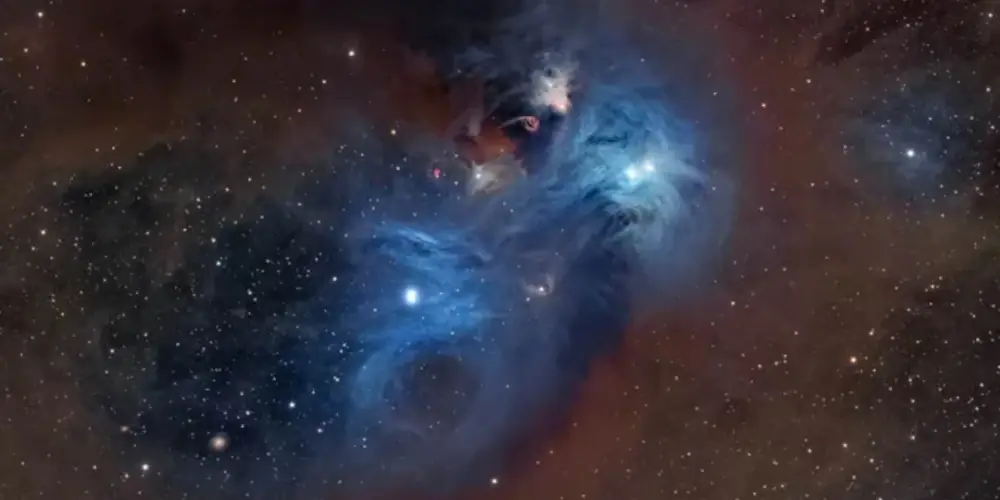
In his newest deep-space image, astrophotographer Greg Meyer turns the cosmos into a canvas. His subject — a nebula shaped like a furious baboon — has been dubbed the Rampaging Baboon Nebula. Streams of gas and dust weave through the frame, glowing in hues that give the scene a startling sense of movement. The photograph spotlights the complex beauty and creative chaos that define our galaxy’s stellar nurseries.
A Nebula Like No Other
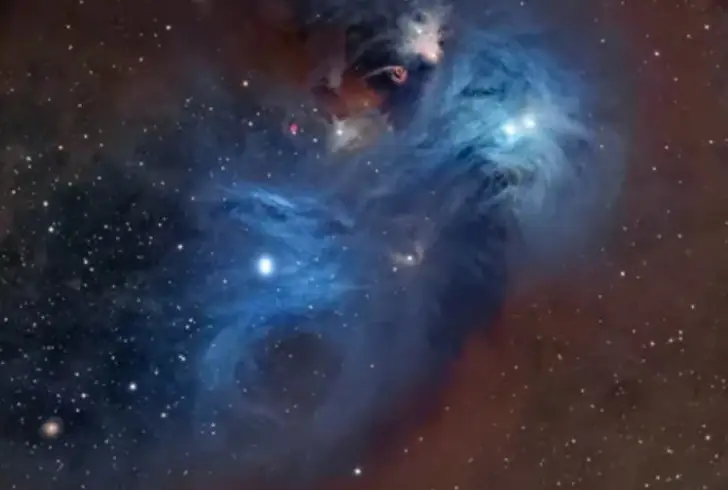
Instagram | futurespaceworld | Rampaging Baboon Nebula is a brightly shining cosmic portrait of a baboon.
The nebula lies about 500 light-years away in the constellation Corona Australis. Its shape suggests the face of a mandrill, with molecular dust sculpting the mouth and facial contours. The bright blue eyes are created by reflection nebulas that scatter starlight, adding a glowing effect.
Nearby, the globular cluster NGC 6723 is visible to the upper right. This cluster is around 30,000 light-years from Earth and contains hundreds of thousands of stars. Together, the nebula and cluster form a vivid, star-studded scene.
Capturing the Celestial Detail
Meyer spent 13 nights over June, July, and August photographing the nebula. Using an Esprit 120mm telescope and QHY 268M astronomy camera, he collected 16.5 hours of exposure. The long observation time was necessary to gather faint light from distant stars and gas clouds.
After capturing the raw images, Meyer processed them in Photoshop, Lightroom, and PixInsight. He noted that detecting the oxygen glow in the nebula was particularly challenging.
“I saw images with some oxygen, but OMG it was faint,” Meyer told Space.com. “Even with 200 ten-minute exposures, the oxygen was barely visible, so I did my best to bring it out for some contrast.”
A Cosmic Showcase
Instagram | gomanastro | Meyer’s image of the Rampaging Baboon Nebula captures the elegance of stellar birth and cosmic motion.
The Rampaging Baboon Nebula is where science meets visual poetry. Layers of dust and gas stretch into intricate, almost sculptural patterns, illustrating how interstellar matter gathers, collapses, and ignites to form stars. Brilliant color contrasts and a nearby star cluster add both depth and luminosity.
It’s a playful reminder that the universe often mirrors the familiar. The nebula’s outline — reminiscent of a baboon’s face — shows how cosmic formations can echo earthly imagery while tracing the birth of new stars.
Through Meyer’s lens, the nebula becomes more than an image — it’s a glimpse into the restless creativity of space itself, where beauty and science continually intertwine.