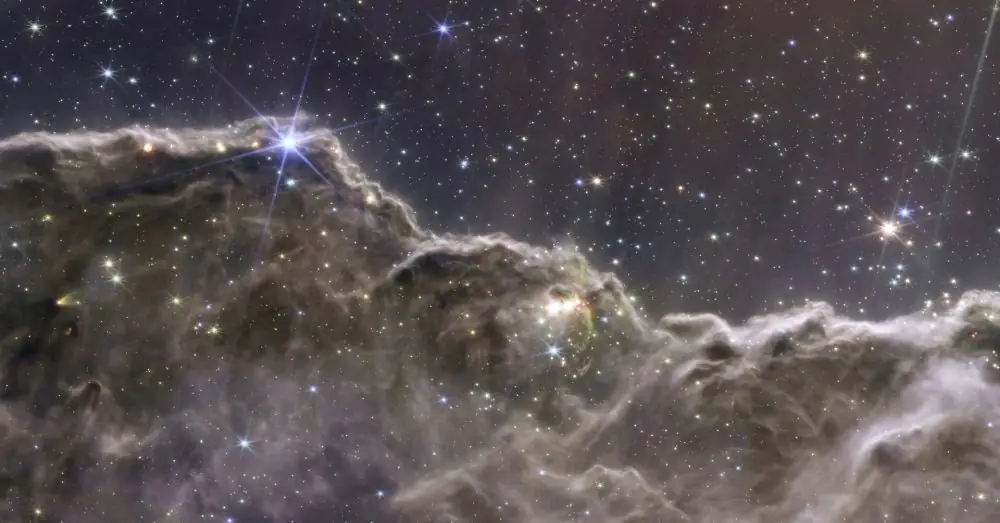
Just a few days into its scientific operations, NASA’s James Webb Space Observatory has already piqued scientists’ interest. They did that in a region of early galaxies. Those that had been beyond the reach of any other telescope.
Galaxies / NASA’s new discovery leads us to a novel perspective of the cosmos, argue scientists.
The things we perceive are entirely novel. “Webb is telling us that there’s a rich cosmos beyond what we thought,” said Tommaso Treu, principal investigator on one of the Webb initiatives from the University of California, Los Angeles. Yet again, the cosmos has taken us by surprise. In many respects, these early galaxies are exceptional.
There are now two studies in the Astrophysical Journal Letters, led by researchers Marco Castellano of the National Institute for Astrophysics in Rome, Italy. And Rohan Naidu of the Harvard-Smithsonian Center for Astrophysics and the Massachusetts Institute of Technology in Cambridge, Massachusetts.
Reuters / NASA discovers two “novel” galaxies that existed after 400 million years of the Bing Bang.
These first results come from two Early Release Science (ERS) programs on board the Webb spacecraft: the Grism Lens-Amplified Survey from Space (GLASS) and the Cosmic Evolution Early Release Science Survey (CEERS).
However, scientists analyzed the GLASS-JWST data over four days and discovered two brilliant galaxies. Though future spectroscopic studies with Webb will help confirm, these galaxies likely existed about 450 and 350 million years after the big bang (with a redshift of around 10.5 and 12.5, respectively).
Additionally, a more distant GLASS galaxy, designated GLASS-z12, whose age is estimated to be 350 million years after the big bang, was discovered using Webb. “With Webb, we were shocked to see the most distant starlight anybody had ever seen,” stated Naidu.
Suzy / Pexels / This discovery paves a new arena of astrology, argue scientists.
Astronomy has now entered a brand-new era and with cutting edge scientific equipment, it’s like discovering an unknown city or artifact during an archaeological investigation. Scientists believe these technological advancements will facilitate the discovery of even more early galaxies by Webb in future deep sky surveys.
Moreover, these galaxies began to clump together. “Also, no one predicted that the Middle Ages would finish so quickly,” said Garth Illingworth of the University of California, Santa Cruz. Additionally, he has worked on the Naidu/Oesch project. The age of the cosmos back then would have been just a tenth of what it is now. In the grand scheme of the 13.8 billion-year-old expanding universe, it’s a blink of an eye.
Illingworth noted the brightness of the two galaxies discovered by these groups. There are no ultra-bright, ancient stars in our immediate vicinity. Moreover, to be sure, the most distant source is relatively compact. Its colors suggest that its stellar population is mainly free of heavy elements. It maybe even contains some Population III stars. Adriano Fontana, a member of the GLASS-JWST team and the second author of the Castellano et al. research, emphasized that only Webb spectra would provide definitive evidence.
Similarly, infrared color measurements determine the Webb distance to these two galaxies. No other observatory compares to the James Webb Space Telescope regarding space research. Webb will investigate the origins and structure of the cosmos and the existence of additional planets outside our solar system.