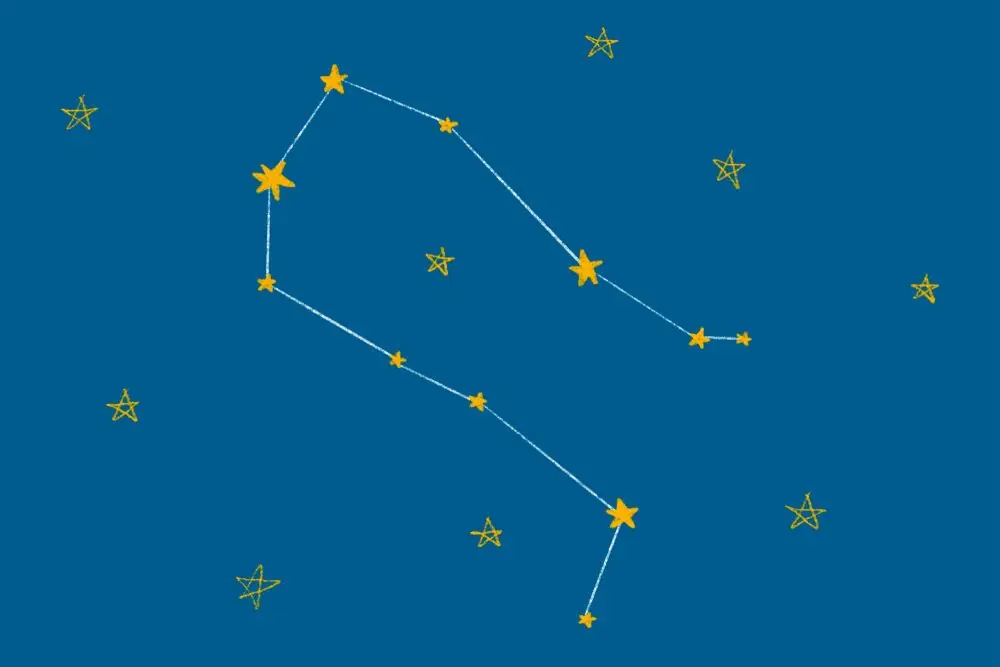
The Gemini star pattern is one of the most fascinating and recognizable sights in the night sky. Known for its twin-like stars, Castor and Pollux, this celestial marvel has captured the imagination of stargazers for centuries.
Whether you are an amateur astronomer or a casual sky-watcher, understanding where to find Gemini, its rich history, and the myths surrounding it can make your stargazing experience unforgettable.
The Gemini star pattern dominates the northern hemisphere’s winter sky, making it a seasonal favorite. Covering 514 square degrees, it is the 30th largest constellation, sitting comfortably in the second quadrant of the Northern Hemisphere. Gemini is best seen during clear winter nights, between December and February, when it shines prominently against the cold, dark sky.
Peeps / You will find Gemini bordered by several dazzling constellations, including Auriga, Orion, and Cancer.
Spotting Gemini starts with finding Orion’s Belt – three aligned stars in a tight row. Draw an imaginary line from Rigel, Orion’s brightest star, past Betelgeuse, his fiery shoulder. Follow that trail, and soon you will meet Castor and Pollux, the unmistakable twin stars that form the heart of Gemini.
The Gemini constellation is defined by its famous pair of stars: Castor and Pollux. These two giants, often referred to as the celestial twins, are bright enough to be easily visible without a telescope. But don’t let their proximity fool you. They are vastly different.
Castor is a dazzling white star system made of six stars, while Pollux, a golden-hued giant, is slightly closer to Earth and hosts an exoplanet in its orbit.
However, what sets the Gemini star pattern apart is its mythology and scientific intrigue. From its role in ancient Greek stories to its use as a celestial marker for winter navigation, Gemini has been celebrated for millennia.
The mythology of the Gemini star pattern traces back to ancient Greece, where it symbolized the twin brothers Castor and Pollux. In legend, Castor was mortal while Pollux was immortal, a gift from their father Zeus. When Castor died, Pollux begged Zeus to reunite them, and the god placed the twins in the sky as a constellation, forever side by side.
Telly / Even today, the mythology of Gemini inspires artists and storytellers, keeping the twin stars alive in our imagination.
This story of eternal brotherhood gave Gemini its association with duality and connection. Across cultures, from Roman to Babylonian, the constellation was often linked to themes of unity and partnership.
One of the coolest things about Gemini is its rich collection of deep-sky objects. Within its bounds lie star clusters, nebulae, and galaxies that make it a treasure trove for astronomers. The Messier 35 star cluster, for example, is a dazzling array of young stars visible even through small telescopes.
You bet! It is a must-see if you are exploring Gemini with a good pair of binoculars.
Plus, the Gemini constellation is home to the famous Geminid meteor shower, which lights up December skies every year. This meteor shower, caused by debris from the asteroid 3200 Phaethon, creates bright, fast-moving streaks across the heavens. Watching the Geminids under the backdrop of the Gemini constellation is an experience you won’t forget.
While the Gemini star pattern is steeped in mythology, some common misconceptions still float around. One myth is that the twins, Castor and Pollux, are identical stars. In reality, they couldn’t be more different. Pollux is a cooler, orange-hued giant, while Castor is a hot, multi-star system with a brilliant white glow.
Another myth is that Gemini is only visible in winter. It is true that winter provides the best views. You can still spot Gemini in the early spring during its gradual descent below the horizon.