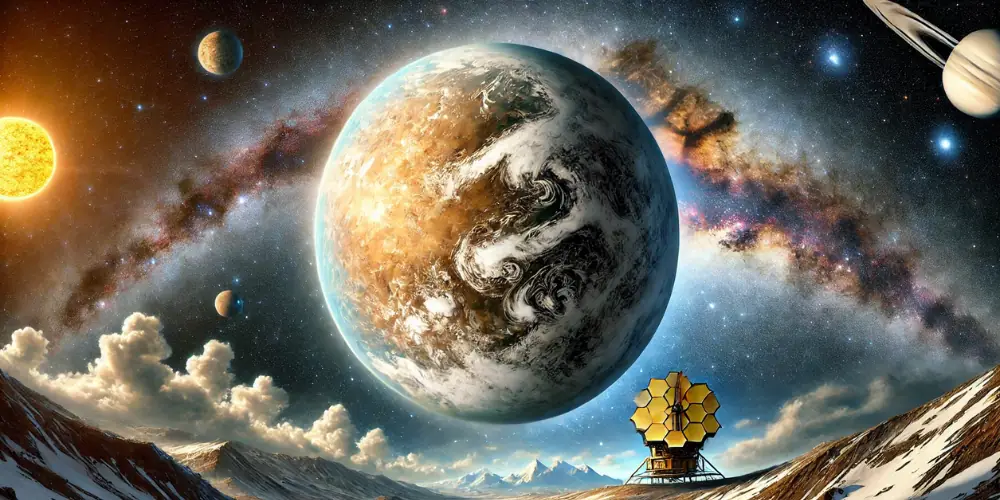
Scientists are on the verge of uncovering potential signs of life beyond Earth, but first, they need to pinpoint where to look. This journey begins with identifying planets that possess atmospheres, a crucial element for sustaining life.
Recent discoveries suggest that a concept called the “cosmic shoreline” could guide astronomers in determining which distant worlds are most likely to retain their air.
Why Atmospheres Matter in the Search for Alien Life
In the late 1970s, NASA’s Voyager and Pioneer 11 spacecraft visited Titan, Saturn’s largest moon, revealing its dense atmosphere of nitrogen and methane. While most moons lack significant atmospheres, Titan’s thick gaseous layer raised a fundamental question: Why do some celestial bodies hold onto their air while others lose it?
Instagram | humanoidhistory | NASA’s Pioneer 11 flying past Titan Saturn’s largest moon helped scientists study why some planets keep their atmospheres.
For decades, scientists believed that a planet’s ability to retain an atmosphere depended solely on its initial composition and gravitational pull. However, data from Mars and other planets hinted at a different possibility—atmospheres could be lost over time. This idea led planetary scientist Kevin Zahnle to map out a pattern, showing a clear division between airless worlds and those wrapped in gas. He called this boundary the “cosmic shoreline.”
Understanding the Cosmic Shoreline
Zahnle’s theory suggests that atmospheric loss plays a more significant role than originally thought. By plotting planets based on their gravity (escape velocity) and exposure to sunlight, he found a striking pattern: rocky, airless worlds clustered on one side, while gas-rich planets occupied the other.
Initially, his idea didn’t gain much attention. Scientists were more focused on how planets acquired atmospheres rather than how they lost them. However, the discovery of thousands of exoplanets—planets beyond our solar system—has given this concept new importance. With powerful tools like the James Webb Space Telescope (JWST), astronomers now have the ability to test whether the cosmic shoreline extends beyond our solar system and into the wider galaxy.
How Planets Lose Their Atmospheres
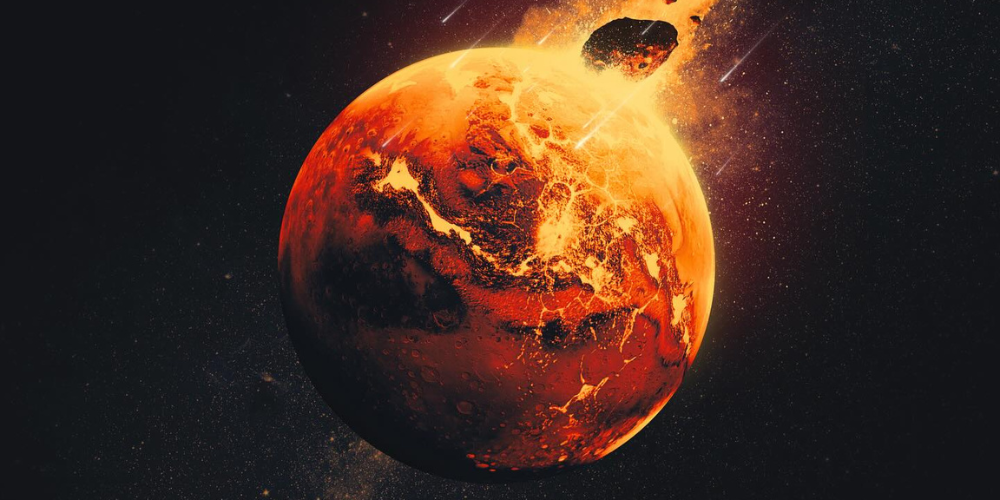
Freepik | Flowo | Asteroid and comet impacts can remove a planet’s atmosphere over time.
Atmospheric loss isn’t a simple process. Several factors determine whether a planet can hold onto its air:
1. Star Radiation – Intense ultraviolet and X-ray radiation from a star can strip away a planet’s atmosphere, particularly if the planet is small and lacks strong gravity.
2. Impacts from Space Objects – Asteroids and comets can collide with planets, blasting away portions of their atmosphere.
3. Extreme Heat – High temperatures can energize atmospheric particles, allowing them to reach speeds fast enough to escape a planet’s gravity.
While Zahnle initially focused on solar radiation, he later found that planetary impacts could be just as influential in atmospheric loss. The problem? Both theories seemed to work equally well.
Exoplanets and the Search for Life
With nearly 6,000 exoplanets identified, scientists are eager to determine which ones might harbor life. JWST, designed for deep-space observations, is now being used to study rocky planets orbiting small, dim stars known as M dwarfs. These stars make up about 70% of the galaxy’s stellar population, making them prime candidates for study.
However, M dwarfs pose a challenge. They emit intense bursts of radiation in their early years, which could strip nearby planets of their atmospheres. Researchers are now testing whether the cosmic shoreline concept applies to exoplanets orbiting these stars. If it does, it could help narrow down the list of planets worth investigating for signs of alien life.
What Recent Studies Reveal
Instagram | nasa_james_webb_telescope | Scientists use James Webb Space Telescope JWST to study TRAPPIST-1 planets for alien life.
Observations of exoplanets in the TRAPPIST-1 system, a group of seven Earth-sized planets orbiting an M dwarf, have provided some early insights. Some of these planets appear airless, aligning with the cosmic shoreline model, while others remain uncertain. Scientists are now measuring temperature variations on these planets to determine whether they have atmospheres.
One method involves analyzing how heat is distributed across a planet’s surface. A world with an atmosphere should have more even temperatures between its day and night sides, while an airless planet would show extreme temperature differences.
The Future of the Cosmic Shoreline Theory
The cosmic shoreline is a valuable framework, but it may oversimplify the factors that determine a planet’s atmosphere. Elements like initial atmospheric composition, geological activity, and long-term climate changes also play a role in whether an atmosphere can persist. Some researchers suggest that even planets that lose their atmospheres might regain them through volcanic activity or other natural processes.
Still, the idea remains a useful guide. By mapping this boundary across different star systems, astronomers can refine their search for habitable planets and potential extraterrestrial life. If the cosmic shoreline proves to be a universal rule, it could help identify worlds with the right conditions for life.
The search for alien life is just beginning, but this framework offers a promising way to focus the efforts. With continued research and advanced telescopes, we may soon be closer to answering one of humanity’s biggest questions: Are we alone in the universe?