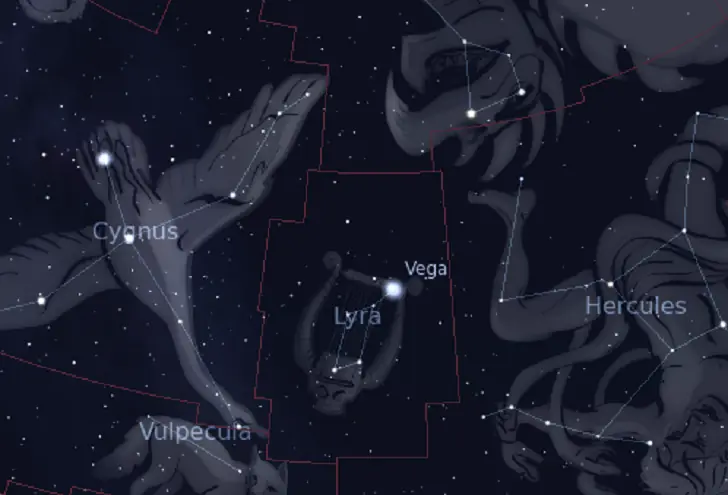
The night sky holds many wonders – among them, the Lyra constellation shines with a unique blend of mythology, history, and celestial phenomena. Known as the harp constellation, Lyra not only captivates stargazers but also serves as a gateway to exploring the rich tapestry of the cosmos.
The harp constellation is steeped in the rich myths of ancient Greece, where it represents the lyre of Orpheus, a legendary musician, and poet whose melodies could enchant the very stones and rivers. Orpheus’s lyre, gifted by Apollo and fine-tuned by the Muses, became a symbol of sublime artistic expression that resonated through the ages. After his tragic death, the gods immortalized Orpheus’s lyre in the sky, transforming it into the constellation we observe today.
Image by Constellation-guide.com | The harp constellation is steeped in the rich myths of ancient Greece.
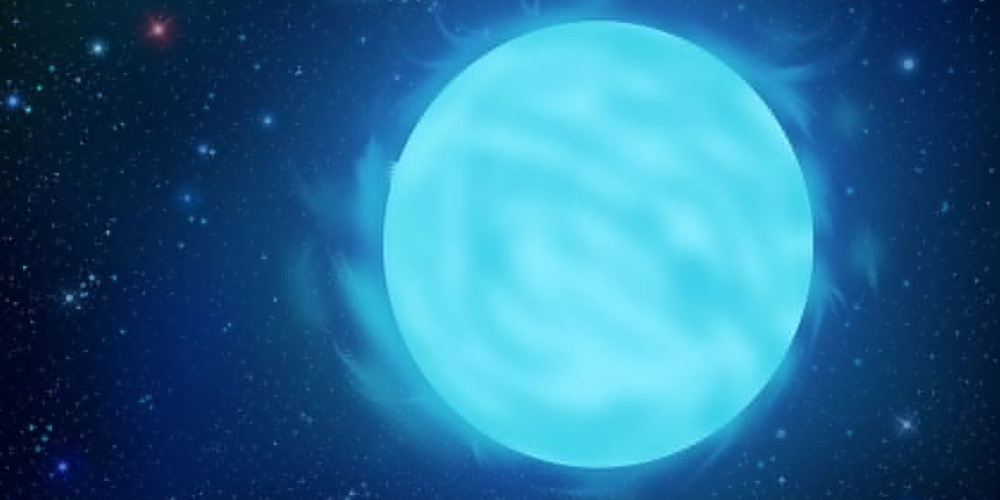
Vega, also known as Alpha Lyrae, is the brightest star in the Lyra constellation and one of the most luminous stars in our night sky. This celestial beacon, located merely 25 light years away from Earth, is often the first point of reference for those navigating the vast ocean of stars above. Its brilliance and proximity make Vega a cornerstone in the study of stellar astronomy, providing insights into the characteristics of A-type stars.
Image by Astrophotographylens.com | Vega is the brightest star in the Lyra constellation and one of the most luminous stars in our night sky.
Sulafat and Sheliak: These stars offer a glimpse into larger celestial bodies’ life cycles and peculiarities. Sulafat, a blue-white giant, and Sheliak, a fascinating eclipsing binary system, showcase the dynamic processes occurring within stars as they evolve.
RR Lyrae: This variable star gives its name to a whole class of astrophysical phenomena known as RR Lyrae variables, crucial for understanding cosmic distances and the scale of the universe.
One of the most photographed and studied objects in the night sky, the Ring Nebula stands out as a quintessential planetary nebula. Located a manageable distance from Vega, this nebula offers a glimpse into the future of our Sun, showing what happens when a star sheds its outer layers, leaving behind a hot core that illuminates the expelled gas.
Alex Andrews | Pexels | The Ring Nebula stands out as a quintessential planetary nebula.
Further enriching the harp constellation’s portfolio are deep sky objects like Messier 56, a dense globular cluster nearly as old as the universe itself, and NGC 6791, one of the oldest known open clusters. These star clusters provide astronomers with invaluable information on stars’ formation, evolution, and ultimate fate.
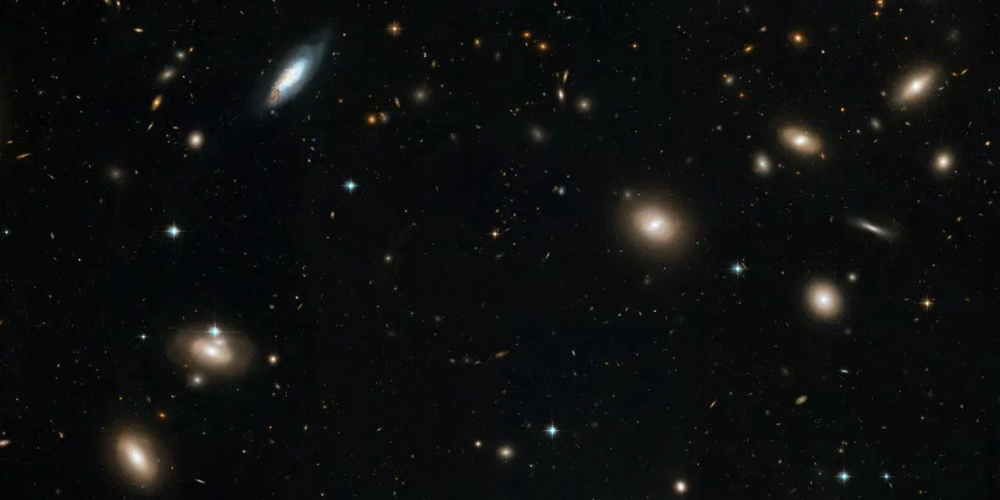
For those who look deeper, NGC 6745 offers a dramatic view of a galactic collision, serving as a vivid reminder of the universe’s dynamic and often violent nature. This interacting trio of galaxies captures a moment in cosmic time, offering a snapshot of gravitational forces at play.
Lyra also plays host to the mesmerizing Lyrids meteor shower, an annual event that lights up the night sky each April. Observers can witness these celestial fireworks, which originate from particles left behind by comet C/1861 G1 Thatcher, as Earth passes through its debris trail.
As we explore the harp constellation, it becomes clear that Lyra is not just a collection of stars but a gateway to understanding the universe’s past, present, and future. Whether you’re a seasoned astronomer or a casual stargazer, Lyra offers a celestial symphony that resonates with the music of the cosmos, inviting all to listen and learn from the stories it has to tell.