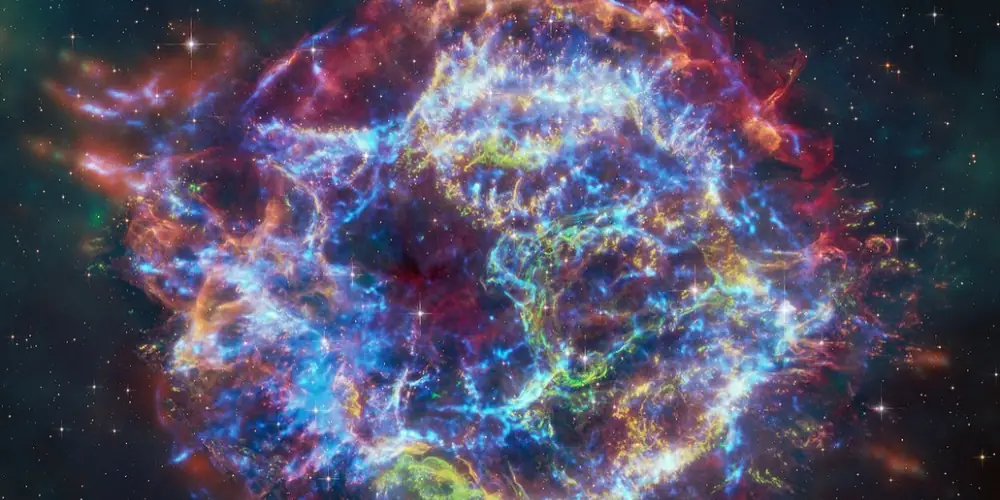
A massive star recently exploded in a way that has astronomers questioning how supernovae release their energy. This event, designated as SN 2024bch, occurred approximately 65 million light-years away from Earth and was first observed in February 2024. It is a Type II supernova, which occurs when a star’s iron core collapses after nuclear fusion stops. Shockwaves then rip through the star’s outer layers, ejecting them into space.
Normally, the energy from these explosions comes from the star’s ejected material slamming into the dense gas surrounding it, called the circumstellar medium. This collision creates narrow emission lines in the light spectrum. SN 2024bch, however, appears unusual.
A Supernova That Breaks the Rules
Instagram | @istitutonazionaleastrofisica | A massive star’s recent Type II supernova is challenging astronomers’ understanding of explosion energy release.
Astronomers describe SN 2024bch as “anti-social” because its ejected material does not collide strongly with surrounding gas. Yet, the narrow spectral lines are still visible.
Key observations include:
1. The supernova was monitored for 140 days by the National Institute for Astrophysics (INAF).
2. Researchers used multiple ground-based telescopes and NASA’s Swift spacecraft.
3. Narrow emission lines were detected despite the lack of strong interaction with the surrounding gas.
This unusual behavior led researchers to explore alternative ways the supernova could produce energy.
Bowen Fluorescence
The INAF team suggests that Bowen fluorescence explains the energy and spectral lines of SN 2024bch. This process, first studied in the early 20th century, involves high-energy ultraviolet light exciting helium atoms. These atoms then pass energy to oxygen and nitrogen, creating the observed narrow emission lines.
Leonardo Tartaglia, lead researcher at INAF, said:
“For the first time in this type of transient, we demonstrate that the primary mechanism is Bowen fluorescence. Our scenario describes all the evolutionary phases of the supernova with great precision.”
This discovery shows that strong interactions with surrounding material are not always needed to produce energy in Type II supernovae.
Impact on Astronomy
Facebook | NASA Explore The Universe | The non-interacting supernova SN 2024bch won’t emit high-energy neutrinos, a key finding for multi-messenger astronomy.
SN 2024bch is reshaping how researchers think about Type II supernovae and may shift the direction of future cosmic studies:
- Rethinking supernova models – Not all Type II explosions may generate high-energy neutrinos, the nearly weightless particles that zip through space at close to light speed.
- Impacts on multimessenger astronomy – Because this supernova shows minimal interaction with its surroundings, it offers no strong source of high-energy neutrinos, limiting its usefulness in studies that combine light, gravitational waves, and neutrino detections.
Tartaglia put it plainly:
“With no evidence of interaction, SN 2024bch doesn’t have the physical environment required to generate high-energy neutrinos. That matters for multimessenger astronomy.”
H₂ and Its Role
Hydrogen molecules remain central to interpreting these explosions. Even in a low-interaction event, H₂ can shape local chemistry, influence emitted light, and contribute to narrow spectral lines without any actual physical collisions taking place.
The findings highlight just how varied Type II supernovae can be. Bowen fluorescence gives astronomers a new framework for understanding certain emissions and challenges the assumption that all Type II events follow the same playbook.
SN 2024bch shows that the universe still has surprises in store, prompting researchers to look more closely at processes that may have been overlooked.