Water is fundamental to life, but its journey to Earth has long puzzled scientists. Observing ice around infant stars could provide crucial clues about where our planet’s water came from.
Recent studies using the James Webb Space Telescope (JWST) are revealing how the water in star-forming regions might resemble the water on Earth, helping scientists understand how planets can become habitable.
The Role of Semi-Heavy Water
One key to uncovering the origins of Earth’s water lies in semi-heavy water, or HDO. In this molecule, one hydrogen atom is replaced by deuterium, a heavier version of hydrogen containing a neutron. Water with a higher HDO-to-H2O ratio typically forms in extremely cold environments, like the dense clouds of gas, dust, and ice where stars are born. Interestingly, Earth’s oceans have a higher HDO ratio than the Sun, suggesting that some of our water may have originated in the cold interstellar cloud that birthed the Sun.
Instagram | friendsofnasa | Semi-heavy water (HDO), which forms in cold, star-forming clouds, is key to tracing the origins of Earth’s water.
Understanding how the HDO-to-H2O ratio evolves around young stars is essential for piecing together the history of water in our solar system. These ratios serve as chemical markers, providing insight into the conditions under which planets acquire their water.
Observing Ice Around L1527
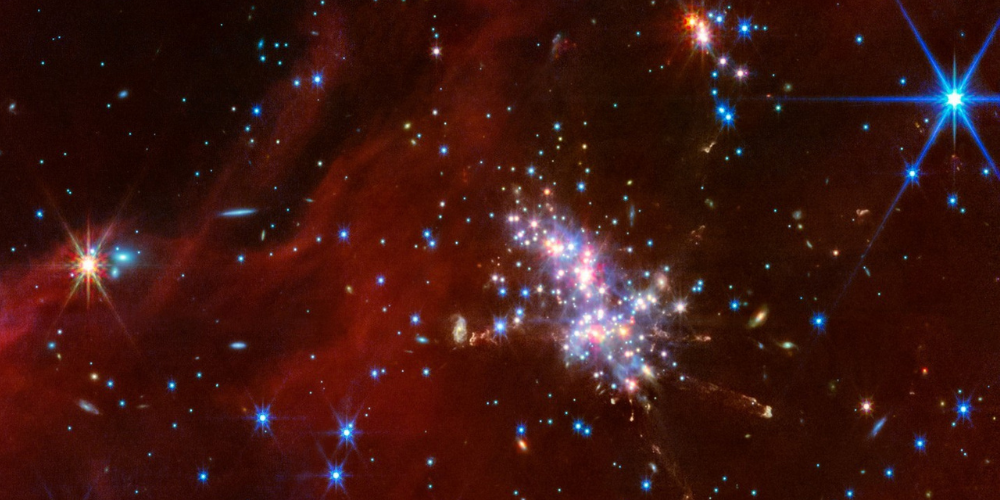
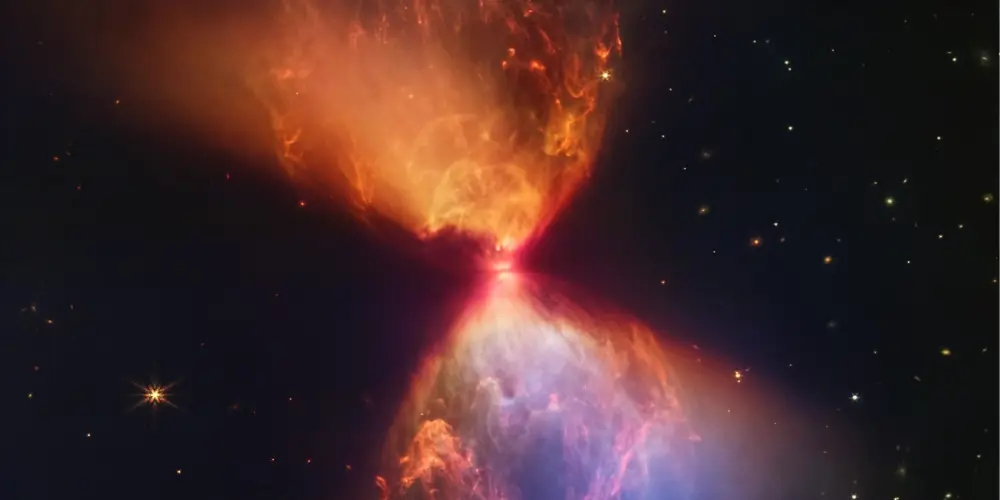
The JWST captured detailed observations of L1527, a star just 100,000 years old. Though tiny compared to our 4.5-billion-year-old Sun, L1527’s size and surrounding dust indicate it could grow to resemble our star. Dust and gas around L1527 form a disk. Some of this material falls onto the star, while the rest may eventually come together to form planets, similar to how the solar system developed.
The telescope also detected a relatively high HDO-to-H2O ratio in the icy material surrounding L1527. By comparing this ratio with those around slightly older stars, researchers found that the proportion of semi-heavy water stays fairly stable as stars evolve.
This discovery allowed scientists to link these ratios to water found on comets and meteorites in our solar system. In this way, distant star-forming regions can be connected to the water present on Earth.
Comparing Ice Across Space
Instagram | nasa | By studying clustered and isolated stars, scientists assess the environmental effect on water.
Astronomers mapping semi-heavy water across star-forming regions have begun to connect the dots between interstellar ice and planetary oceans. Their work spans both gas and solid forms, focusing on:
- Carbonaceous Meteorites – Primitive asteroids that may have delivered Earth’s first water. Their HDO/H₂O ratios mirror those of young molecular clouds.
- Oort Cloud Comets – Believed to have formed far beyond our solar system, these icy bodies offer a glimpse into how water chemistry varies across stellar nurseries.
- Jupiter Family Comets – Born closer to the Sun, these comets act as time capsules, helping scientists understand how water migrated and endured in the solar system’s inner regions.
- Young Stars in Clusters vs. Solitary Systems – Comparing stars that form in groups with those developing in isolation allows researchers to see how the environment shapes water’s evolution and stability.
- Using the JWST, scientists also observed larger, brighter infant stars to broaden their dataset. When these measurements are compared with Earth’s ocean water, they begin to paint a picture of how water traveled from interstellar ice to worlds capable of sustaining life.
- Implications for Planetary Habitability
- Findings from the L1527 system reveal that icy materials play a vital role in forming planets. The stable ratios of semi-heavy water suggest that much of a system’s water survives the tumultuous early phases of star birth—a hopeful sign for the potential habitability of planets elsewhere.
This suggests that planets forming in these disks may inherit water with chemical traits similar to Earth’s. Observing both ice and gas around young stars helps scientists better understand water’s origins.
These studies reveal how life-essential molecules travel across the galaxy and may reach habitable worlds. Studying ice around baby stars also provides clues about Earth’s water. This brings researchers closer to solving the mystery of how water—and possibly life—spreads across the universe.