At the heart of the Milky Way, where stars orbit dangerously close to a supermassive black hole, some of them may be living on borrowed time—or not aging at all. New research explores an extraordinary idea: certain stars near the galactic center might be powered not by fusion alone, but by the energy released from collisions between dark matter particles and their antimatter counterparts.
This concept doesn’t just challenge conventional models—it reshapes what we understand about stellar evolution.
What Shapes a Star’s Life?
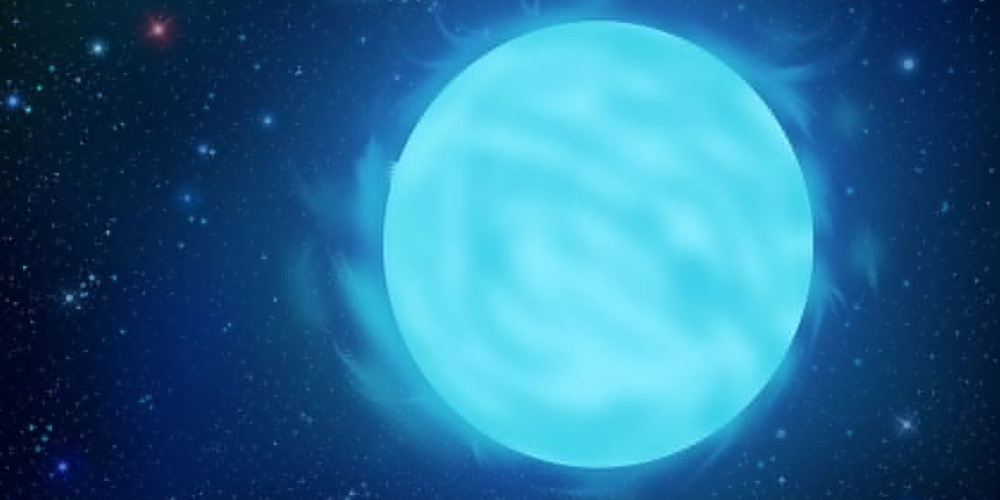
Instagram | jeffkenipulver | A star’s entire evolution, from burning hydrogen to its final fade, is controlled by its mass.
The foundation of a star’s life lies in its mass. Mass determines how quickly a star burns hydrogen, when it moves on to heavier elements, and how it ultimately fades. The “main sequence” is a chart astronomers use to map out these life stages. It’s a trusted system based on how stars produce energy through nuclear fusion.
But what if there’s another energy source in play? One that’s constant, independent of fusion, and only available in very specific places—like the dense, dark-matter-filled region near the Milky Way’s core?
Dark Matter’s Unseen Influence
Although dark matter has never been directly detected, scientists widely believe it’s made of elementary particles. If true, it likely includes both matter and antimatter versions. When these particles meet, they annihilate each other and release energy.
Under normal conditions, those collisions are rare. But at the galactic center—where dark matter is concentrated more densely than anywhere else in the galaxy—the rate of annihilation could be high enough to change how nearby stars behave.
At one point, excess radiation was observed in that area, and many suspected dark matter was the cause. That theory was eventually ruled out for that specific radiation, but the larger question remained: what could this type of energy do to stars orbiting close to the black hole?
Rewriting the Main Sequence
Three astrophysicists—Isabelle John, Rebecca Leane, and Tim Linden—ran detailed simulations to explore what happens when stars absorb energy from dark matter annihilations. Their work modeled stars ranging from 1 to 20 times the Sun’s mass and inserted them into a high-density dark matter environment near the galactic core.
These stars didn’t start their lives there. They likely formed farther out and migrated inward over time due to gravitational interactions. As they reached the center, the stars began absorbing dark matter energy in addition to their usual fusion output.
Two collision frequencies were modeled to account for how often dark matter particles might collide. This extra energy was layered onto the fusion output, and the stars were allowed to evolve within this new energy-rich context.
What Happens to the Stars?
The effect on these stars depends heavily on their mass and average distance from the galactic center:
1. Lower-mass stars
These could receive so much energy from dark matter that their fusion processes nearly shut down. They appear much younger than they are, essentially reversing along the main sequence.
2. Moderate-mass stars
Some were pushed beyond the threshold where they could remain stable. These stars may dissipate entirely—blown apart by the excess energy.
3. High-mass stars
These managed to hold together. Some even abandoned fusion altogether, living entirely off dark matter energy. They appear like newly forming stars, but in reality, they’ve already burned through nuclear phases and now sit in a suspended, seemingly immortal state.
The simulations also revealed that these changes are highly sensitive to location. A star that thrives on dark matter annihilation at one orbital range might collapse or evolve normally just one light-year farther from the core.
Real Stars, Real Questions
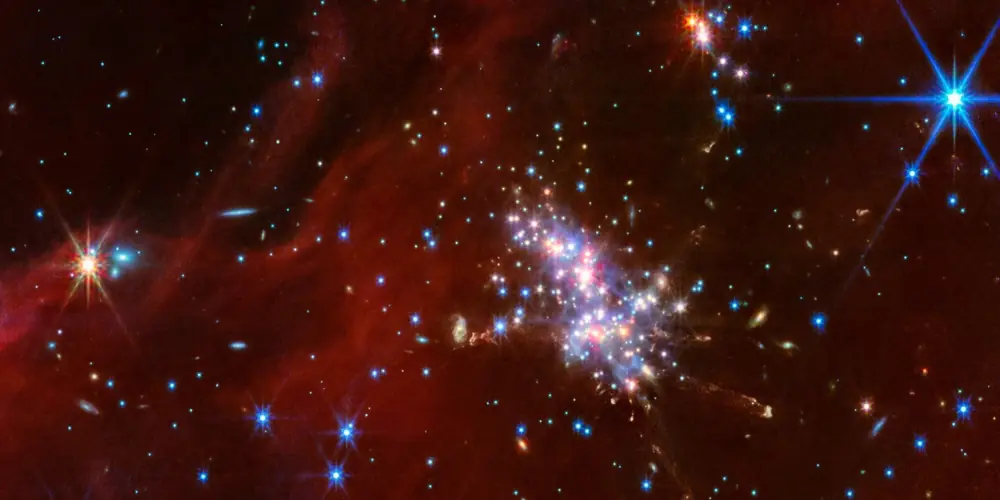
Instagram | nasahubble | Observations of the galactic center’s unusually massive and young stars support the study’s predictions.
Interestingly, the study’s predictions line up with what astronomers have already observed in the galactic center. Many stars there are unusually massive and appear younger than expected. If low-mass stars can’t survive the intense energy environment, only larger ones would remain, making the population appear skewed. And if fusion has slowed or ceased, these stars would still look young despite their age.
Still, the models are based on average orbital distances, not the pulsating energy changes a real star would experience as it moves through different dark matter densities. Future simulations might use real orbital data to produce more accurate insights.
The Possibility of Eternal Stars
If dark matter annihilation is truly at play, it could mean some stars are living in a permanent energetic balance—no longer aging in the conventional sense. This doesn’t just tweak the edges of astrophysics; it raises questions about how stars are categorized and understood.
With more powerful telescopes and long-term observations, astronomers may soon be able to confirm whether these “dark main sequence” stars are real. If they are, it would mark a fundamental shift in the science of how stars live—and how long they can last.
Stars May Not All Follow the Same Rules
What fuels a star has always seemed straightforward—gravity, pressure, and nuclear fusion. But deep in the galactic core, stars may be getting their life force from something far more elusive. The potential presence of dark matter–powered stars opens up an unexpected dimension of astrophysics.
While this theory needs more observational support, it’s already offering possible explanations for the mysterious, massive, and oddly youthful stars seen circling the Milky Way’s black hole.