
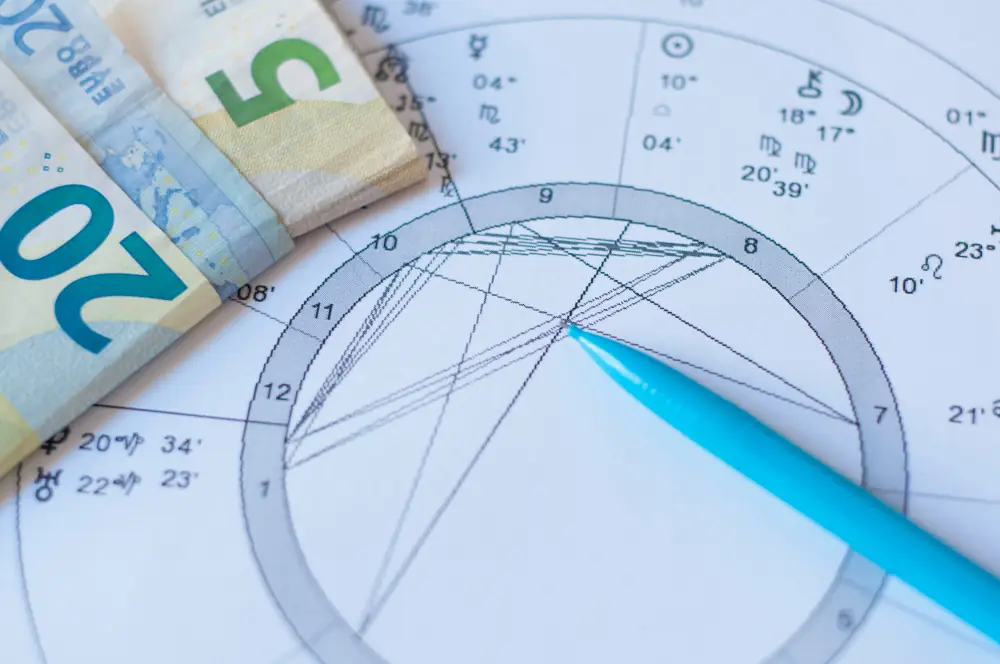
Investors use a variety of tools to make decisions, from stock screeners to economic indicators. However, some choose a different approach, turning to the stars. Financial astrology claims that celestial bodies, such as the sun, moon, and planets, influence market trends and economic activity. While many view it with skepticism, this niche field has a devoted following, with proponents suggesting it offers unique market insights.
Financial astrology, also called economic astrology or astro-economics, connects planetary movements with financial market trends. This practice stems from traditional astrology, which studies the influence of celestial bodies on human behavior and events. Financial astrologers claim that the same cosmic forces affecting personal lives also impact economic cycles and market behavior, offering the potential for predicting financial trends.
Supporters of financial astrology believe that by tracking celestial patterns, they can identify market cycles, fluctuations in asset prices, and even the success of individual investments. Despite the lack of scientific proof, numerous books, podcasts, and courses exist on the subject, drawing in both amateur and seasoned investors looking for an edge.
Hindustan Times | MSN | Financial astrology connects planetary movements with financial market trends.
At its core, financial astrology operates on the belief that the universe functions in cycles, much like the financial markets. Financial astrologers argue that planetary alignments can impact investor sentiment and market trends, as the moon’s gravitational pull influences ocean tides. By observing these planetary movements, they aim to predict price fluctuations in stocks, commodities, and other assets.
However, it’s important to note that no scientific studies have confirmed the accuracy of financial astrology. Traditional financial analysts remain skeptical of its predictive power, emphasizing that market movements are driven by a complex combination of economic factors rather than planetary positions.
Financial astrologers use several methods to try and forecast market behavior. An essential tool is the natal chart, which records the positions of celestial bodies at a specific time and location. Some astrologers create natal charts for companies based on their incorporation date or the birthdate of a CEO. Combined with historical market data, these charts help astrologers identify patterns that might indicate future market movements.
Another essential tool is the ephemeris, a table that tracks the positions of celestial bodies over time. By studying the movement of planets, astrologers look for planetary alignments or aspects that could coincide with significant market shifts, such as mergers, acquisitions, or changes in commodity prices.
The moon plays a significant role in financial astrology, as many astrologers believe its phases correlate with market highs and lows. The idea is to buy assets when the moon is waning (believed to be a low point for markets) and sell during waxing phases (when markets are expected to rise). Eclipses are seen as moments of unpredictability, where caution is advised.
Surprisingly, some academic research supports a potential connection between moon phases and market behavior. A 2006 study by University of Michigan economists found that stock returns were lower around full moons compared to new moons. However, the researchers emphasized that this correlation might be random and shouldn’t be used as a reliable investment strategy.
People | MSN | Many Astrologers believe Moon phases correlate with market highs and lows.
In financial astrology, different planets are believed to govern various sectors of the economy. For instance, the sun is associated with leadership and luxury industries, while the moon influences public sentiment, real estate, and consumer goods. Mercury is linked to communication and trade, and Venus governs financial matters, particularly banking and luxury markets.
Other planets, like Mars, Jupiter, and Saturn, represent energy, expansion, and structure, respectively. Financial astrologers study the interactions between these planets to predict which sectors might experience growth or downturns based on planetary alignments.
One of the primary risks of financial astrology is the lack of evidence supporting its claims. While some astrologers insist on its validity, there’s no scientific foundation to suggest that planetary movements influence financial markets. Additionally, astrologers often provide conflicting advice, leading to potential confusion or misguided investment decisions.
Another issue is confirmation bias, where investors focus only on information that supports their astrological predictions, ignoring other market data. This can result in missed opportunities or poor financial outcomes. Ultimately, relying solely on astrology for investment decisions can be risky, leaving investors vulnerable to market volatility.