
“The Truman Show” isn’t just a standout ’90s drama—it’s a razor-sharp commentary on surveillance culture, media obsession, and the cost of living under constant scrutiny.
Directed by Peter Weir and starring Jim Carrey in a rare dramatic role, the film tells a story that still hits hard today, especially in an age where personal privacy feels more optional than protected.
Released in 1998, “The Truman Show” foresaw a world not unlike ours—where real life gets filtered through a lens for public consumption, and entertainment blurs the line between genuine and artificial.
A World Built on Illusion
Truman Burbank lives in the pristine town of Seahaven, a place that looks picture-perfect but is anything but real. From the weather to his neighbors and even his wife—everything around him is scripted. The twist? Truman doesn’t know any of it.
He was born on a set and has spent his entire life as the unwitting star of the world’s most-watched TV show. His daily life is broadcast to millions, 24/7, without his consent.
Instagram | izreviewz | Truman Burbank lives a scripted life in the deceptively perfect, unreal town of Seahaven.
This isn’t just about voyeurism; it’s about control. Every emotion, decision, and dream Truman has is shaped by producers pulling the strings. Led by Christof, a godlike figure voiced by Ed Harris, the show’s creators manipulate Truman’s world to keep him grounded and oblivious.
That manipulation is central to the film’s message—highlighting how easily personal freedom can be stripped away when people are treated like content instead of individuals.
Truman as a Reflection of Society
Truman’s curiosity grows as the illusion begins to crack—quite literally, when a stage light labeled “Sirius” falls from the sky. As oddities pile up, he begins questioning everything, realizing that his reality doesn’t quite add up. His suspicions mirror the feelings of many in today’s media-driven world. Surveillance isn’t just fictional—phones, apps, and social media feed on personal details, much like the cameras in Truman’s life.
There’s a powerful metaphor in Truman’s growing self-awareness. His name itself—Tru-man—suggests authenticity. But to become truly himself, he has to break free from a life built on lies. It’s not just about leaving a TV set; it’s about reclaiming agency.
The Power Play Behind the Curtains
At its core, the film critiques those who orchestrate these false realities. Christof represents more than a showrunner—he’s the embodiment of corporate media dominance, deciding what Truman sees, feels, and fears.
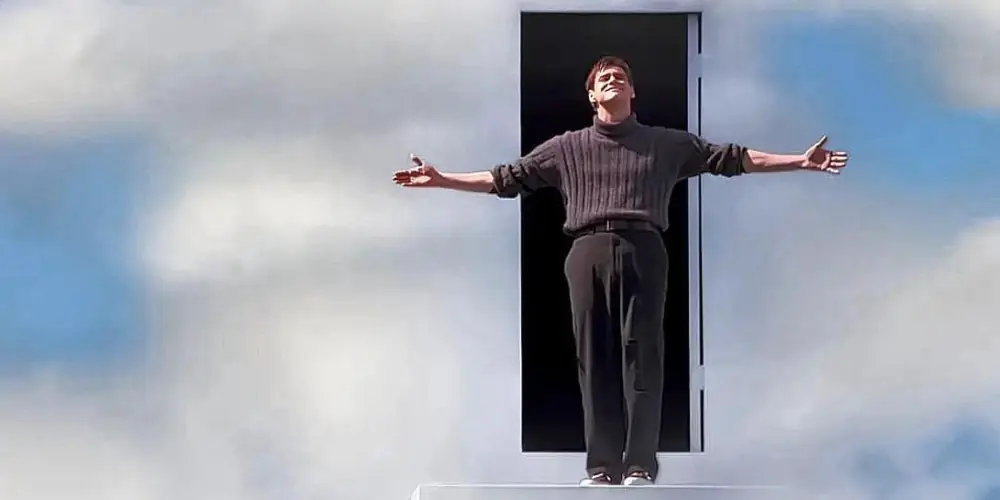
In one of the film’s most symbolic moments, Truman confronts his fear of water—implanted by Christof through a staged tragedy—and sails beyond the horizon, only to find a painted sky and a literal wall.
When Truman reaches the edge, Christof tries one last time to convince him to stay. From the heavens, he speaks to Truman like a god talking to his creation. Truman’s response—“You never had a camera in my head”—is a quiet act of rebellion. It’s a reminder that internal thought, no matter how monitored a person may be, remains untouched.
An Ending That Says More Than It Shows
Instagram | izreviewz | Truman’s final “good afternoon, good evening, and good night” sign-off marks his liberation, but the real world quickly moves on
As Truman exits through the door at the edge of the set, he delivers one last line to the world: “In case I don’t see ya, good afternoon, good evening, and good night.” It’s the sign-off of a man taking back his story. Audiences in the film cheer, but the real-world irony comes seconds later—two security guards watching the broadcast simply switch to another channel.
That moment captures something subtle yet chilling: entertainment moves on. Even when someone’s life changes forever, viewers may not notice. The film doesn’t scold its audience, but it does hold up a mirror.
Watching Truman’s life unfold is uncomfortably similar to how real-life social media and reality shows are consumed. Emotional moments, private conflicts, personal breakthroughs—they’re all just part of the stream.
Lasting Relevance of “The Truman Show”
More than two decades later, “The Truman Show” still resonates. Its themes of surveillance, consent, media addiction, and identity are even more relevant today. Modern platforms—from TikTok to live vlogs—feed a similar appetite for authenticity, even if it’s curated and monetized.
The story also asks deeper questions: Who gets to decide what reality looks like? And at what point does entertainment cross the line into exploitation? Truman’s quiet rebellion speaks volumes—it’s not loud or dramatic, but it is deliberate and earned.
Whether seen as a satire, a sci-fi drama, or a social warning, “The Truman Show” delivers a compelling message wrapped in a tightly written, emotionally driven story. And while the cameras fade to static at the end, its echo in today’s culture remains impossible to ignore.